
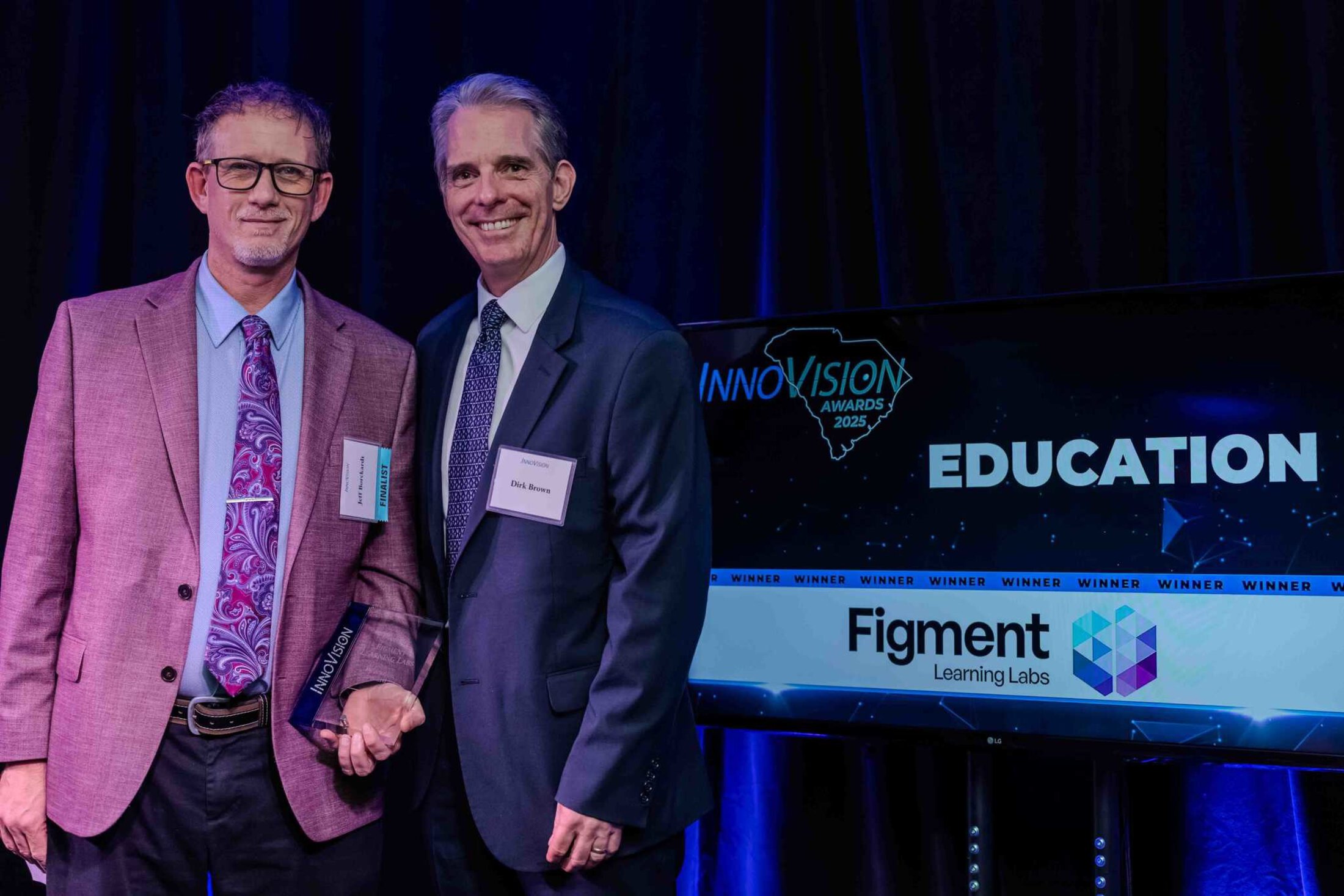
The Medical University of South Carolina (MUSC) was strongly represented at the 2025 InnoVision Awards, with startup companies earning the top status in the Education category and placing as a finalist for the Technology Development area. The win represents a first for an MUSC startup company, having had five previous finalists since the organization’s launch.
The InnoVision Awards celebrate organizations across South Carolina that are pushing boundaries in science, technology and business. Each year, an independent panel of judges evaluates applicants for their creativity, technical impact and potential to transform industries. Overall, three finalists are named yearly in the following categories:
- Technology Development.
- Technology Application.
- Small Business.
- Education.
- Sustainability.
- Community Service.
- Young Innovator.
- Dr. Charles Townes Individual Achievement.
The Education winner, Figment Learning Labs, is an MUSC startup spun off from Jeff Borckardt, Ph.D. Figment Learning Labs builds interactive AI-powered virtual patients, which allow students in the health professions to participate in digital simulations and practice clinical interviewing, diagnostic reasoning and differential diagnosis.
This benefits students by allowing them to interact and engage with lifelike virtual patients who respond naturally and evolve, unlike static and outdated traditional case studies.
“To be the first MUSC spin-off to receive an InnoVision Award is an honor, and it reflects the supportive culture of innovation at MUSC,” said Borckardt. “Figment began as a small idea inside our academic environment, and seeing it grow into something that can improve clinical education nationwide has been incredibly meaningful.”
A clinical psychologist and professor at MUSC, where he also serves as the assistant provost for Interprofessional Initiatives, Borckardt said the idea for the company came from seeing firsthand the difficulties students experienced in engaging with traditional methods as well as the mounting challenges facing modern hospitals and universities.
“The idea came from watching students struggle to connect classroom learning with real- world practice,” said Borckardt. “Most case studies don’t capture the complexity or emotional nuance of real patient conversations. Additionally, hospitals and universities face a number of challenges, including faculty shortages, limited clinical placements and rising training costs. That’s where we realized AI could help to fill that gap.”
Using the program, students now have access to unlimited practice opportunities and receive immediate feedback, all without increasing the workload on faculty. This makes the platform not only an educational tool but also a scalable solution for institutions faced with resource constraints.
“We believe that AI can make education become even more human, not less,” said Borckardt. “Winning the InnoVision Award is incredibly validating. Figment Learning Labs was built to give students fun, engaging and realistic clinical simulations they can access anytime. Part of our core mission has always been to create meaningful and authentic interactions and experiences that prepare students for real-world clinical encounters. Seeing that mission recognized by the innovation community means a great deal to our team.”
Startup company OncoBLAZE was also named one of three finalists for the Technology Development Award. Spun off by Dieter Haemmerich, Ph.D., OncoBLAZE is developing an emerging technology designed to more precisely deliver chemotherapy drugs to cancer cells. Early studies in mice suggest it may help target remnant cancer cells after surgical tumor removal and could one day reduce the risk of recurrence. While still in preclinical testing, the approach signals a promising direction for postoperative cancer care and has the potential to influence future standards of care if validated in human studies.
“Traditionally, patients are given chemo drugs for cancer treatments, usually as much as a patient can tolerate,” said Haemmerich. “You then hope enough of the chemo drug goes to the cancer cells, but usually, only a tiny amount goes to the actual cancer cells, with the rest going to other organs and tissue. This means most patients don’t get a sufficient amount of the chemo drug to all their cancer cells, leading to a high rate of recurrence.”
Cancers such as head and neck cancers and soft tissue sarcomas have high rates of tumor recurrence after surgery, with limited treatment options at that point. Patients often face challenging surgeries followed by therapies that can affect their quality of life. Precision chemo delivery aimed at killing remnant cancer cells will eliminate the need for follow-up therapies that are undesirable for the patient, as well as costly.
This is done by encapsulating chemo drugs in lipids or fat particles and injecting them like traditional chemotherapy. The twist, though, is that these particles prevent the chemo drugs from going to other organs and tissues by being heat-sensitive.
“By exposing these particles to mild heat, such that you would get from a hot bath, they release the contained chemo drug exactly where you want it to be. With a heating device, we can heat the tissue exactly where you know the cancer cells are," explained Haemmerich.
The results show that up to nearly 30 times more drug is delivered to the targeted cancer cells compared with conventional chemotherapy. A recent awardee of its second Small Business Technology Transfer Phase I grant by the National Institutes of Health (NIH) and another from the National Science Foundation (NSF), OncoBLAZE is preparing to start Phase 1 clinical trials shortly. Haemmerich said the recent recognition is strong validation of their research and patent.
"These awards from NIH and NSF experts in the field confirm there is a reasonable chance it’ll work. These milestones bring us closer to translating this innovation to human patients, where the need for effective recurrence prevention therapies is critical.”

Reece Funderburk
Recent Research stories