


Artificial intelligence is transforming healthcare clinical practice, education, research, and administrative operations. As AI becomes increasingly integrated into the tools, workflows, and decisions that shape our work, developing AI literacy is no longer optional. It is essential.
At MUSC, we believe there can be no AI transparency without AI literacy. Individuals cannot appropriately evaluate AI-generated outputs, identify limitations, recognize bias, exercise professional judgment, or use AI responsibly without first developing the knowledge and skills needed to understand how AI works, where it can fail and the importance of human agency in the age of AI.
For this reason, MUSC has taken a strategic and intentional approach to AI literacy. As part of our commitment to preparing an AI-ready workforce, we have established governance guidance, educational resources, literacy pathways, and professional competency frameworks designed to support responsible AI adoption across the academic health system. These efforts are guided by a shared goal: helping students, faculty, clinicians, researchers, staff, and leaders develop the knowledge, skills, and judgment needed to navigate an AI-enabled future.
Leadership Commitment to AI Literacy
In the video below MUSC leadership, provost John Marymont, M.D.and chief artificial intelligence officer Marylyn Ritchie, PhD shares the institution's commitment to preparing students for an AI-enabled future and to advancing responsible, transparent, and informed AI use across our academic health system.
What Is AI Literacy in MUSC’s Context?
AI literacy can mean different things to different people. To establish a shared definition across the enterprise, MUSC adopted the Digital Education Council’s definition of AI literacy:
The essential knowledge and skills needed to understand, interact with, and critically assess AI technologies.
Along with this shared definition, MUSC also adopted the Digital Education Council AI Literacy Framework as the institutional foundation for AI literacy development.
The Digital Education Council AI Literacy Framework
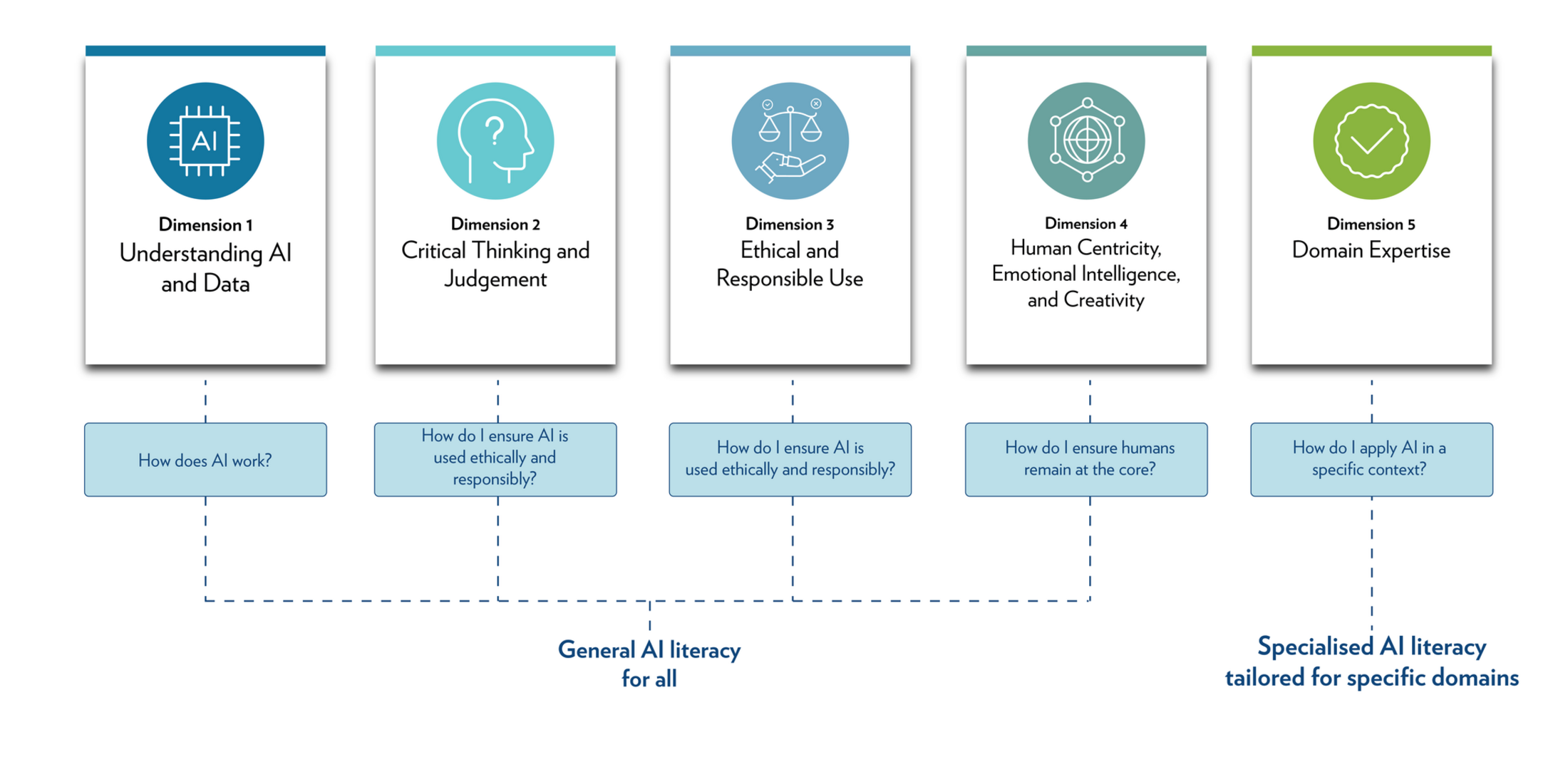
The Digital Education Council AI Literacy Framework organizes AI literacy into five interconnected domains that collectively support effective and responsible AI use with human agency at the core.
- Understanding AI and Data
- Critical Thinking and Judgment
- Ethical and Responsible AI Use
- Human-Centered AI Practice
- Domain Expertise
The framework is intentionally positioned in two categories: General AI Literacy for All and Specialized Professional AI Literacy.
General AI Literacy for All
The first four domains ( Understanding AI and Data; Critical Thinking and Judgment; Ethical and Responsible AI Use; Human-Centered AI Practice) represent foundational AI literacy competencies relevant to all individuals, regardless of discipline, role, or profession. They focus on understanding AI systems, evaluating outputs, exercising critical judgment, recognizing limitations and bias, using AI responsibly, and maintaining appropriate human oversight.
Specialized Professional AI Literacy
The fifth domain, Domain Expertise, recognizes that AI literacy must ultimately be contextualized within professional practice. While foundational AI literacy is universal, the knowledge, skills, and judgment required to apply AI effectively vary across professions and disciplines.
For MUSC, this distinction is particularly important. Preparing an AI-enabled healthcare workforce requires both a shared foundation and healthcare-specific competencies aligned with the standards, workflows, risks, responsibilities, and expectations of professional practice. In the video below we share more about the DEC AI Literacy Framework in the context of MUSC.
From a Foundational Framework to Healthcare Competencies
While the Digital Education Council’s framework provided a strong foundational starting point, MUSC AI Education Committee (A working group with representatives across the enterprise that was established to advance AI education across MUSC and support the development of an AI-ready workforce) took the work a step further to develop the MUSC AI Competency Framework for Health Professionals, which translates the Digital Education Council AI Literacy Framework into healthcare-specific competencies and performance expectations. The MUSC framework translates the DEC framework’s five dimensions into healthcare-oriented domains and defines 17 competencies relevant to clinical, research, educational, administrative, and operational practice. The framework therefore does not represent a separate model of AI literacy. Instead, it extends MUSC’s established AI literacy foundation into the professional settings in which healthcare learners and workers must demonstrate readiness.
MUSC AI Competency Framework for Health Professionals | 5 domains, 17 competencies
| DEC-Aligned Competency Domain | MUSC Healthcare Competencies |
| Domain 1: Understanding AI and Data | C1: Evaluating AI Systems and Applications C2: Assessing Healthcare Data Quality C3: Verifying AI Outputs |
| Domain 2: Critical Thinking and Judgment | C4: Evaluating AI-Generated Outputs C5: Evaluating AI Bias and Equity |
| Domain 3: Ethical and Responsible AI Use | C6: Applying AI Ethics Principles C7: Protecting Sensitive Data C8: Navigating the AI Regulatory and Legal Landscape |
| Domain 4: Human-Centered AI Practice | C9: Maintaining Independent Professional Judgment C10: Communicating Transparently About AI C11: Directing AI for Complex Tasks C12: Evaluating AI Delegation Appropriateness C13: Supervising AI Systems and Workflows C14: Evaluating Emerging AI Capabilities C15: Contributing Expertise to AI Evaluation |
| Domain 5: Domain Expertise | C16: Operating Discipline-Specific AI Tools C17: Investigating and Escalating AI Tool Failures |
Creative Commons License and Attribution
The MUSC AI Competency Framework for Health Professionals, along with its visual elements and iconography, is licensed under a Creative Commons Attribution-NonCommercial-ShareAlike 4.0 International License (CC BY-NC-SA 4.0). It is an adaptation of the Digital Education Councils AI Literacy Framework, and collaboratively developed by the Medical University of South Carolina's AI Education Committee and faculty and staff from across the university. You are permitted to share, remix, adapt, and build upon this material for non-commercial purposes, provided you credit MUSC AI Education Committee and DEC AI Literacy Framework (2025), and license any new creations under identical terms. Commercial use is prohibited. All adaptations must maintain the same licensing terms and clearly attribute both this framework and the original Digital Education AI Literacy Framework.
How to Cite:
Medical University of South Carolina, AI Education Committee. AI Competency Framework for Health Professionals. October 2026.
AI Literacy: Awareness to Readiness
MUSC uses a developmental progression from awareness to literacy to readiness. Each level has a defined purpose, audience, and pathway for continued development.
- Purpose: Establish a Shared Foundation for ALL MUSC learners and employees
- How: A short 20 minute online course created by MUSC for MUSC delivered through our HR learning platform. The course titled, AI at MUSC: Transforming Education, Research, and Healthcare, introduces foundational AI concepts, institutional expectations for responsible use, enterprise AI initiatives, and common risks and limitations associated with AI systems. As the awareness layer of MUSC’s AI Education Ecosystem, it provides the foundation for continued development from awareness to literacy and readiness. There are two versions
- Student version: Required for all first-year students
- Employee version: Available as an optional professional-learning opportunity
- Progress to Date: More than 5,100 students and employees have completed Awareness level AI Literacy Training though the AI at MUSC: Transforming Education, Research, and Healthcare course.
- Purpose: Expand AI awareness to deepen AI knowledge and develop the skills and judgment needed to understand, evaluate, and apply AI technologies in professional contexts.
- How: MUSC’s literacy pathways differ by audience but share a common foundation in the Digital Education Council AI Literacy Framework.
Literacy Pathways Across MUSC
| Audience | Literacy Pathway |
| Students | DEC × MUSC AI Literacy for All and discipline-specific learning experiences |
| Faculty, educators, and academic leaders | DEC certificate programs, faculty development, and role-specific professional learning |
| Healthcare professionals and operational leaders | AI Catalyst and healthcare-specific AI learning opportunities |
| Researchers | Clemson-MUSC AI Hub and AI-focused research training opportunities |
| Employees using Microsoft 365 Copilot | Copilot Champion Network and workflow-focused professional development |
- Purpose: Work and Curriculum Integration that extends the AI Literacy level 2 to developing specialized workforce and discipline specific skills through opportunities to apply, demonstrate, and assess those capabilities in authentic educational and professional contexts.
- How: MUSC AI Competency Integration Playbook designed to help programs incorporate the 17 MUSC competencies into existing curricula. The playbook includes adaptable task templates that can be contextualized to the authentic learning experiences, clinical settings, and professional responsibilities of different disciplines, including medicine, nursing, pharmacy, dentistry, health professions, and graduate studies.
South Carolina AI-Ready Healthcare Workforce Initiative
This readiness work is currently ongoing and strengthened by MUSC being awarded $100,000 over two years through the South Carolina AI-Ready Healthcare Workforce Initiative, supported by the South Carolina EPSCoR ADAPT program. The initiative represents one of the first implementations of the MUSC AI Competency Framework for Health Professionals and serves as an early model for how AI readiness can be taught, practiced, assessed, and evaluated within authentic healthcare environments.
The project uses competency-based medical education and simulation-based learning to prepare learners and physicians to use AI-enabled medical devices safely, ethically, and effectively within authentic clinical workflows. Participants follow a connected patient case from admission through discharge, encounter representative AI-enabled devices across phases of care, and determine how AI-generated information should inform patient care decisions.
AI Literacy Pathways Resources
MUSC community members have access to the following resources to move from foundational awareness toward role-specific literacy and professional readiness. A Net ID is required for some of the resources
- AI at MUSC Course for Employees - 20-minute foundational awareness course in OurDay
- DEC x MUSC AI Literacy for All - Student learning pathway (Single Sign on)
- DEC AI in Higher Education Certificate (faculty/staff single sign on)
- Clemson-MUSC AI Hub - AI- and data-focused research learning opportunities
- Copilot Central SharePoint Site - Microsoft 365 Copilot learning resources and guidance
- Copilot Champion Self-Nomination Form - Join the distributed learning and support network
- BoodleBox - Email boodlebox@musc.edu to request access
MUSC Institution Memberships to Take Advantage of in Building AI Literacy
In addition to the resources above MUSC has institutional membership to the following organizations that offer AI Literacy Resources. Remember to use your MUSC email address when signing up.
|
Organization |
Description | Sign up Links |
Direct Resource Links |
| Health Management Academy: AI Catalyst | Healthcare-focused AI education available through MUSC membership | AI Catalyst Login: Enter MUSC Email Address and you will receive a link. | AI Catalyst Hub |
| AAC&U | Evidence-based pedagogical frameworks, assessment rubrics, and curricular institutes. | AAC&U Log in or Create an Account | AAC&U Website |
| Digital Education Council (DEC) | Global readiness frameworks, assessment design reports, and international working groups. | Request Digital Education Council Member Access - Complete the brief survey, approval takes 24–48 hours. | Digital Education Council Member Portal |
| Educause | Higher education research, specialized teaching tool kits, and peer community group | Create an Educause Profile | EDUCAUSE AI Library |
| Online Learning Consortium (OLC) | Field-tested frameworks and collaborative professional development for digital and blended instruction | OLC Log in or Create an Account | OLC Website |
| UPCEA | Professional education benchmarks, workforce strategy reports, and credentialing tool kits. | UPCEA login or create an account | UPCEA Website |
Moving Forward
AI literacy is becoming a foundational capability for learning, work, and professional practice. Technologies will continue to evolve, but the need to understand, critically evaluate, and responsibly apply AI will remain constant.
By adopting a shared definition, establishing a common framework, translating that framework into healthcare-specific competencies, and building audience-specific pathways for implementation, MUSC is helping learners and professionals move from awareness to literacy and from literacy to readiness for AI-enabled practice.