
Leah Tichy, a MUSC College of Medicine student, was awarded a Center for Global Health Student & Trainee Travel Grant pursue a global health project in La Paz, Bolivia. View more photos of her time in country in this Flickr photo gallery.
From the second I landed in Bolivia, I was immediately immersed in the culture, language, and lives of the people there.
The first morning of rotations I woke up to breakfast cooked by my host mom, Emma, a grandmother of 3 who hosts foreign students in her downtown La Paz apartment. I walk about 20 minutes through the city to COSSMIL, the military hospital where I have my first week of rotations in ambulatory pediatrics. From the minute I step into Dra. Rojas office I am thrown into the life of a Bolivian medical student. “¿Cuáles son las medidas antropométricas que tomamos para hacer una evaluación nutricional?” “What are the anthropometric measurements that we take to do a nutritional evaluation?” So began a week of working with Bolivian med students to learn, understand, and apply a comprehensive nutritional evaluation for each patient that came into clinic. Dra. Rojas explains to us the historical trends of stunting, one of Bolivia’s major public health priorities, which has decreased significantly since their Zero Malnutrition program was implemented in 2008. She shares with us her passion for preventative care and emphasizes the importance of using growth charts for every patient and tracking nutritional status at every visit. This would later go on to inspire the research project that I worked on for the remainder of my time there.
My learning did not stop once I stepped outside the hospital doors. From there I returned home to a lunch, sopa de zapallo, a common dish in La Paz, before attending Spanish class organized by Child and Family Health International (CFHI), the organization I was traveling with. Here me and another MUSC student had the opportunity to practice Spanish with our instructor in a low-stakes setting, chatting about our days, reading medical articles, and practicing common patient encounters. From here, we go to lecture with Dr. Cecilia Uribe - our in-country mentor and pediatrician at Hospital Los Andes - to learn about the Bolivian healthcare system and various government programs they have specifically to support women and child health.
Then it's time to go to the gym, where I learn not only the conversion from kilometers to miles, but the unique challenges you're presented with when trying to run at 12,000 feet. In the evening, my fellow students and I meet to get dinner at one of the local restaurants and share about our days. Before we head to our rooms we play a few games of Lobo, a variant of Rummy, with our host mom - who always loved to practice with us before she went to play with her friends the next day.
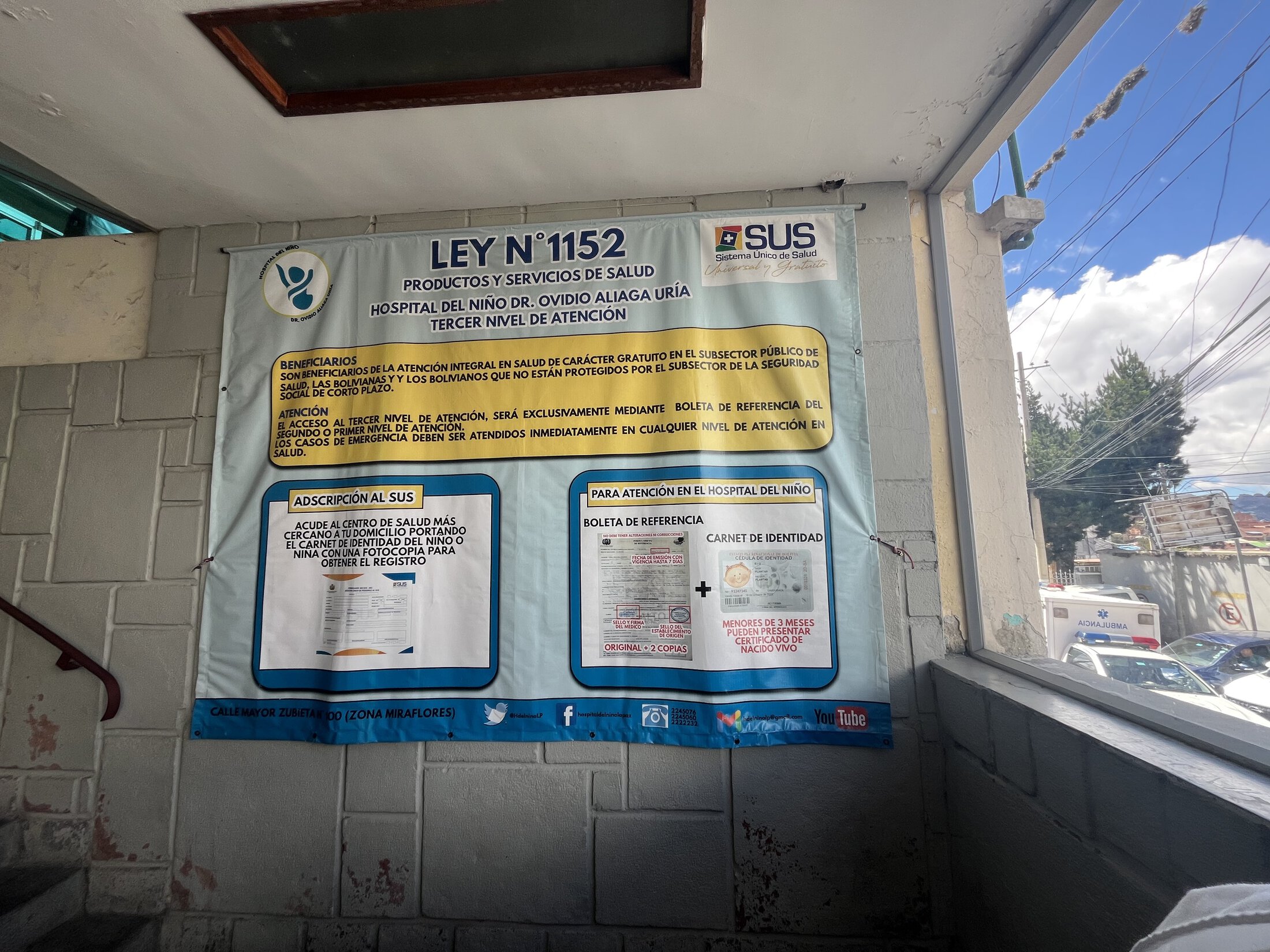
In the following weeks, I was able to rotate at Centro Materno Infantil Santa Maria de los Angeles, a private clinic for mothers and children in El Alto - a neighboring city in the Andean highlands - in addition to Hospital los Andes and Hospital del Nino- both of which are public hospitals providing free care to all citizens. Here I shadowed physicians, residents and interns and worked with students as they provided care ranging from performing newborn exams and annual physicals to treating children with pneumonia. Bolivia is one of a few countries in the world to incorporate traditional medicine into their formal healthcare system and it was interesting to learn from physicians how they integrate traditional healers into the hospital setting. This respect for patient autonomy and cultural practices combined with knowledge of when allopathic interventions may be necessary and how to approach these conversations are skills I wish to learn myself and bring into my future practice of medicine.
What stuck with me most was how warm and welcoming everyone I encountered was. Some residents would take me to each patient room after rounds and explain each condition and treatment plan in a one on one setting where I could ask questions. Other med students would lead me to grand rounds and help me understand the structure of the hospital and their role. Even outside of the hospital, strangers were incredibly helpful in navigating the teleférico, their form of public transportation, especially when a line was down and I had to find a new way to get myself to the hospital.
We had opportunities to travel in and around La Paz as well. From hiking the Muela del Diablo, to visiting the famous salt flats and island of the sun, we experienced the tourist highlights and the hidden local gems of the Bolivian countryside. My time in Bolivia was incredibly impactful, from learning more about the differences in the healthcare system there, to improving my Spanish, to exploring a new place and learning about a new culture. I will always remember my time here with great fondness.
Recent Center for Global Health stories